
Pentiment: Fools and Features

Time to Beat: 17.9 Hours
Despite the enjoyment gained by writing about video games, I prefer to read brief reviews. I worry about information spoiling my objectivity. My sources include Polygon and Second Wind, along with trailers on Steam. If a game offers even a hint of enticement, I put it on my Steam wishlist.
Though I purchased Pentiment, I had no hint of its story, mechanic, or genre. Fortunately, Pentiment is a 2022 release by renowned studio Obsidian Entertainment. I've played many of their games including KOTOR II, Neverwinter Nights 2, and Fallout: New Vegas, as well as Pillars of Eternity, Tyranny, Pillars of Eternity II, and The Outer Worlds.
Each of those previous games was either an action RPG or a classic RPG, but Pentiment is a RPG in the barest sense. Playing Pentiment is akin to reading a medieval manuscript or watching a Shakespearean play, with a few caveats. First, the dialogue isn't difficult. Second, since it is a game, the player makes choices that alter the flavor of their story. I have, on occasion, criticized similar games as walking simulators. Or worse; stories that deceive the player into imagining their choices matter. Let me be penitent.
When I criticized What Remains of Edith Finch, it was on the basis of its story. If a developer sacrifices gameplay for plot, the game becomes a book that must be judged on the merits of its story. Consider, would I rather play Tacoma or read a book? In the latter case I'd choose a book, but Pentiment is preferable.
The story of Pentiment begins in the fictional town of Tassing in Bavaria. The year is 1518. The player controls protagonist Andreas Maler, a journeyman artist laboring at a monastery for money. In his free time he works on his masterpiece.
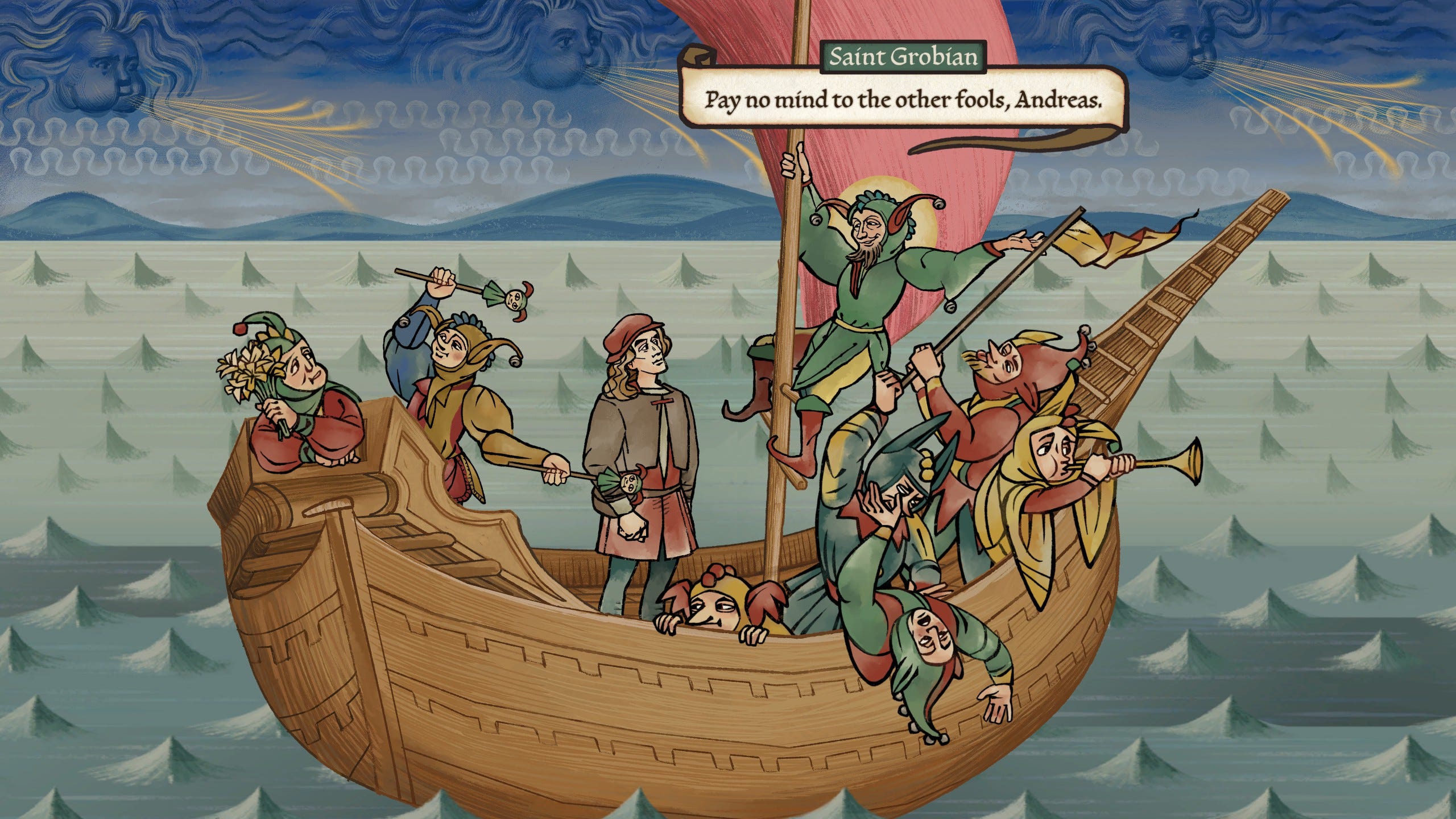
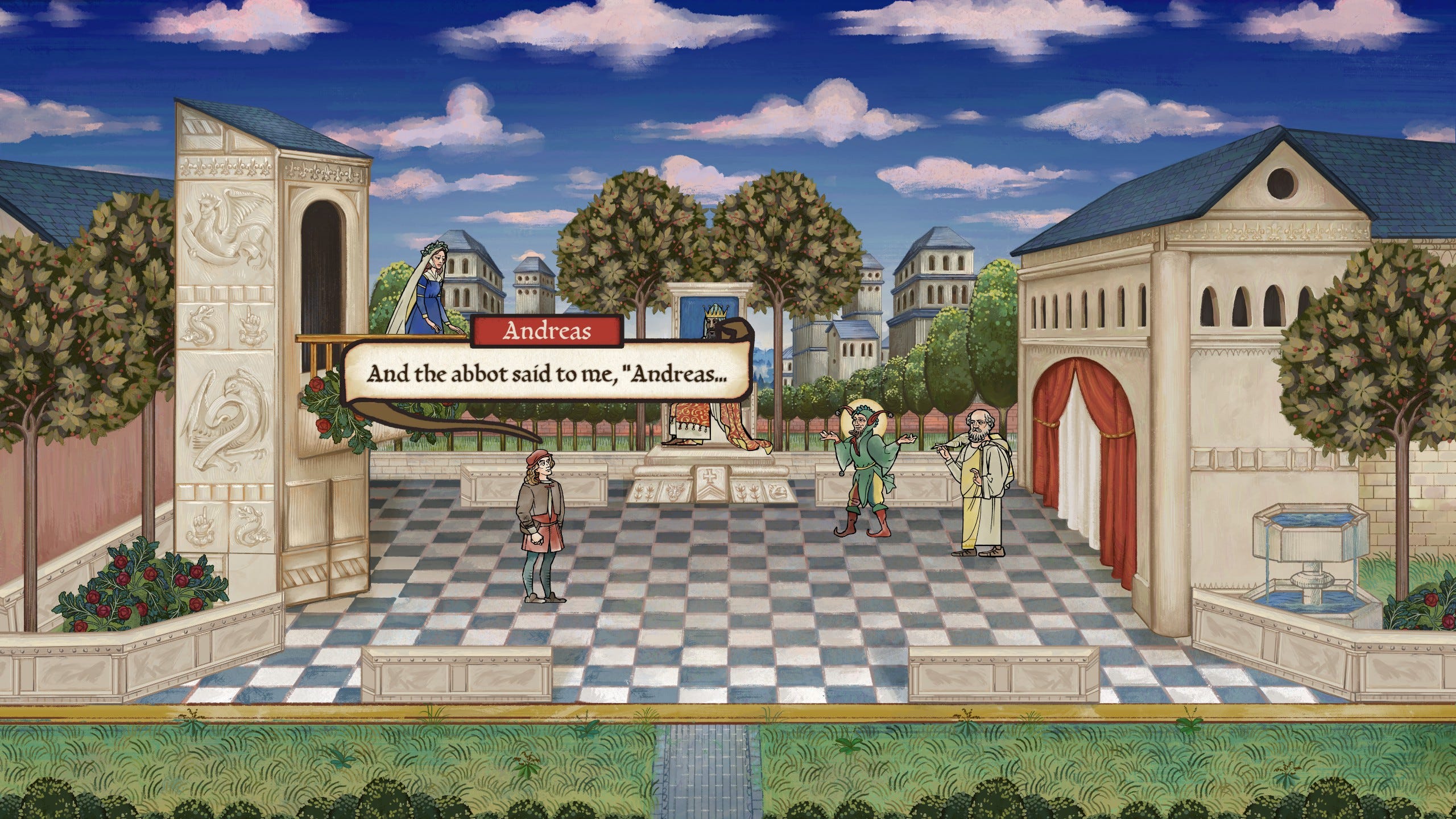
Before Andreas arrives at work, Pentiment opens on a beautiful stage, depicting the mind of an artist. Besides Andreas, the court includes King Prester John, Socrates, Saint Grobain, and Beatrice. They are rendered as intricate illustrations in a manuscript. The characters are two dimensional figures on a level background. Despite their flat appearance, they move about on the scenery in a manner that creates perspective. In this opening the famous four counsel Andreas.
They each represent aspects of his mind that connect with their obvious allusions. Beatrice represents the woman of Dante's fame, while John rules the lost Christian Kingdom. Socrates comes from Plato's Apology. I admit I knew nothing of Grobain, whom the internet assures me is an obscure patron saint of vulgar people. They present as a Damsel, King, Abbot, and Fool, representing the appropriate virtues. Later when Beatrice transforms into Melancholia, Pentiment makes this point explicit, describing her change from Prudence to Despair. Though I love this introduction, I vehemently reject Socrates' connection with the Catholic Church.
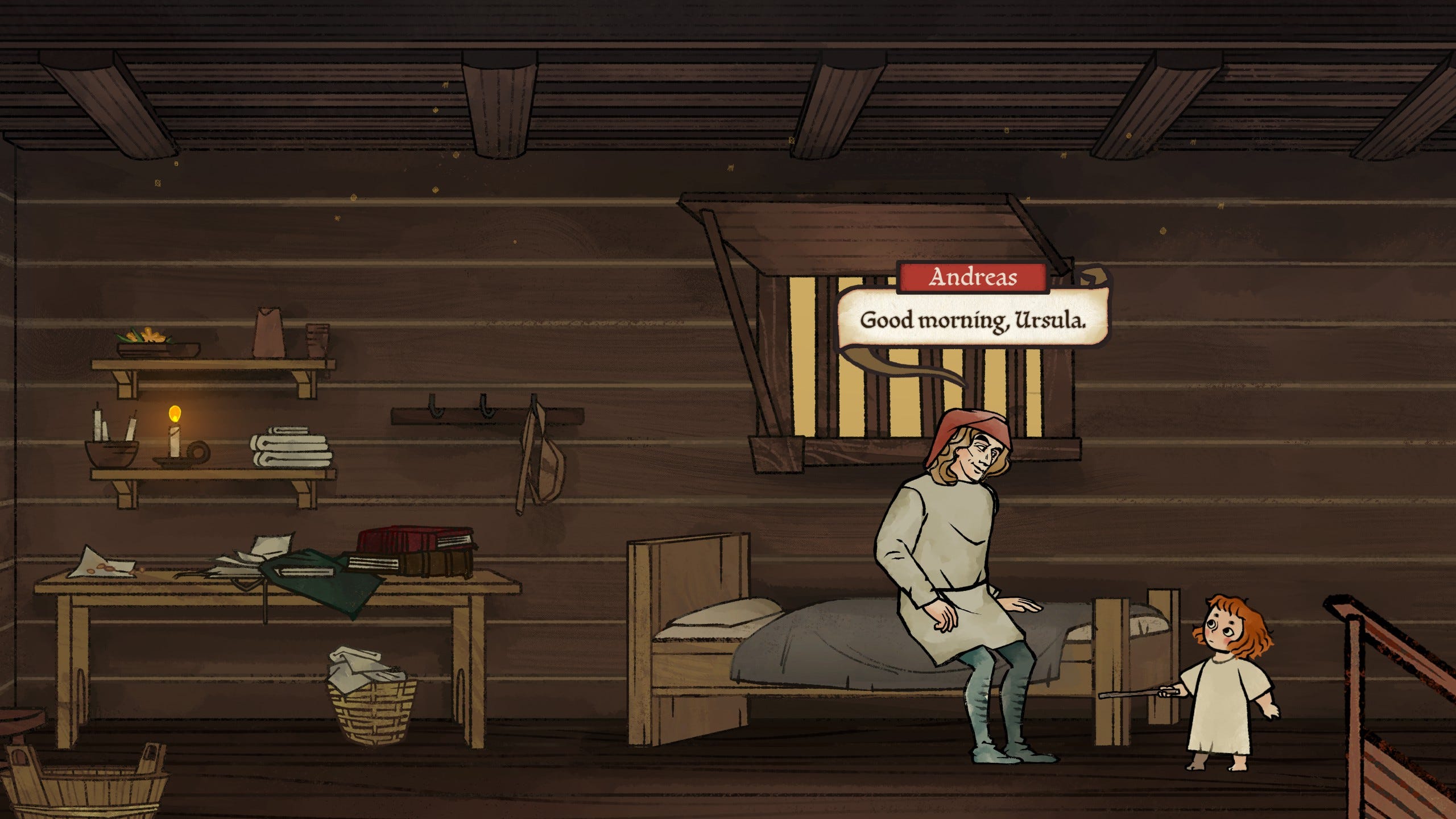
In this section the player chooses between dialogue options to direct the conversations of Andreas' mind. While these may not determine the plot, they let the player reflect on their intentions. As dawn draws near, a boat of fools sets sail with Andreas aboard. He sails through a night and day, into a house, where a little girl Ursula taps Andreas awake with a stick. She mutters "GooOU-um Andurrrr" as a morning greeting.
The player never hears any spoken words, but sound accompanies dialogue. The sounds are of a quill scratching out the words of the characters. The sound and style changes depending on the character's profession. The words of the local printer's words are printed in a single action. Pentiment is packed with writing , and its sounds. When dialogue includes a name or reference of importance, the game underlines the text in red. Clicking Tab zooms out to show the story on the page of a book. The margins display a picture of the character, or a short description of the underlined word. Opening menus creates an exaggerated sound of turning the pages of a book.
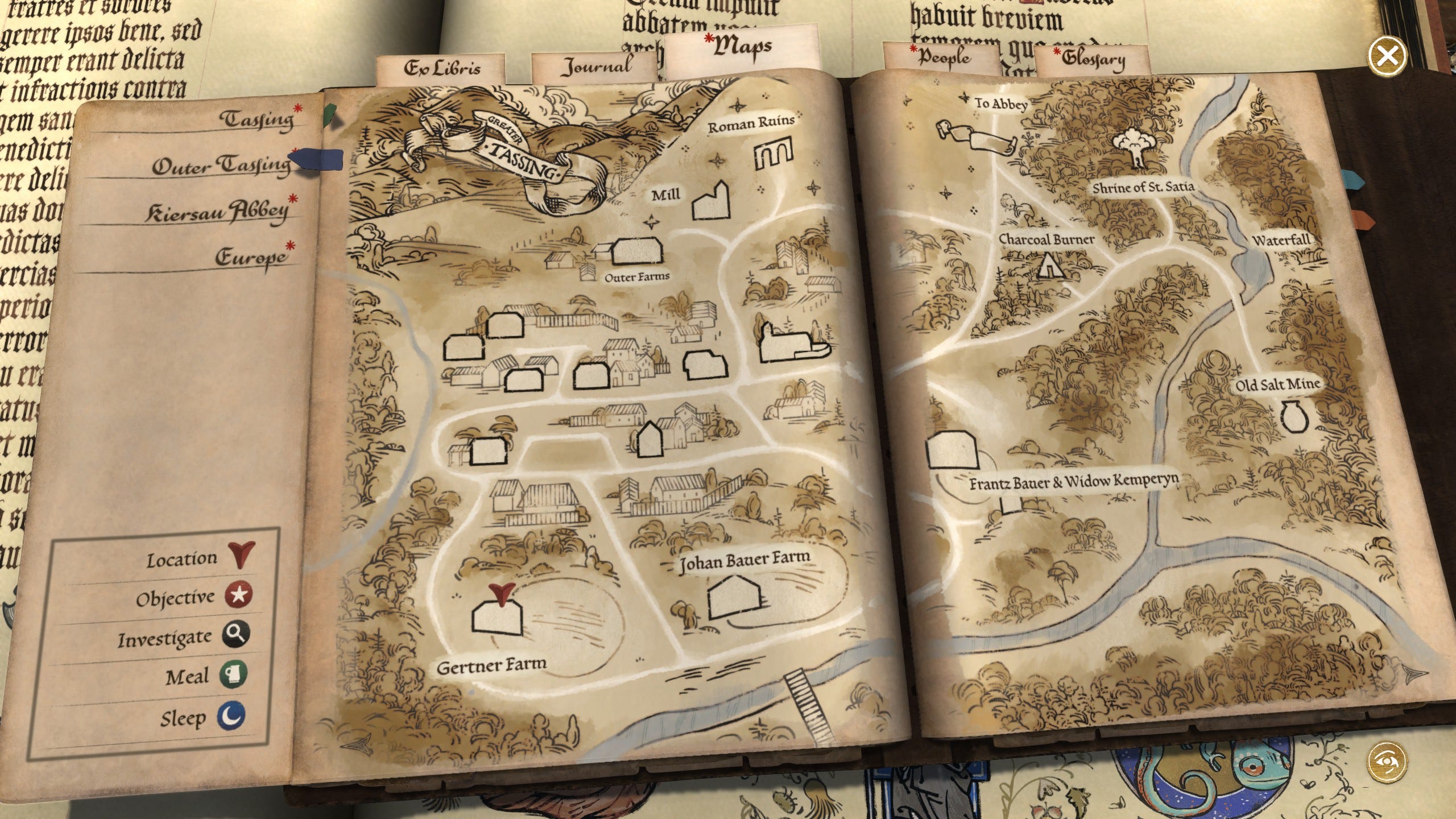
A different button opens a journal with details for every character in Tassing. Pentiment also includes a map, and a journal listing events, goals, and missions. The map is helpful enough, with names of locations, and indicators for activities. The journal, as record of Andreas' thoughts, isn't organized with the player in mind. The journal is enjoyable as a source of information, but with so many characters, it's difficult to locate the necessary details.
Walking downstairs Andreas encounters his landlord Clara Gertneryn. Pentiment contains over 60 unique characters, each with a unique visual appearance that distinguishes them, while informing their personality. Andreas' interactions reveal their background of ideas, interests, past events, and connections. In only a minute I'm part of the Gertneryn family. The household includes Clara's daughter Ursula, her stepchildren Big Jorg and Eva, and her bitter and overworked husband Peter. When Clara asks if I can ask my employer, the Abbot, for an advance to pay the rent, I'm eager to assent.
These charming farmers are barely subsisting. They live in a ridiculous situation. They pay rent to the Abbot. I'm asking the Abbot to pay me early. I'll give my salary in rent to the Gertneryns, and they'll hand it back to the Abbot. Though the player doesn't know it, Pentiment is introducing a conflict that spans decades. The economic conflict, between the taxes of the Abbey and the plight of the farmers, is a powerful backdrop for Pentiment.
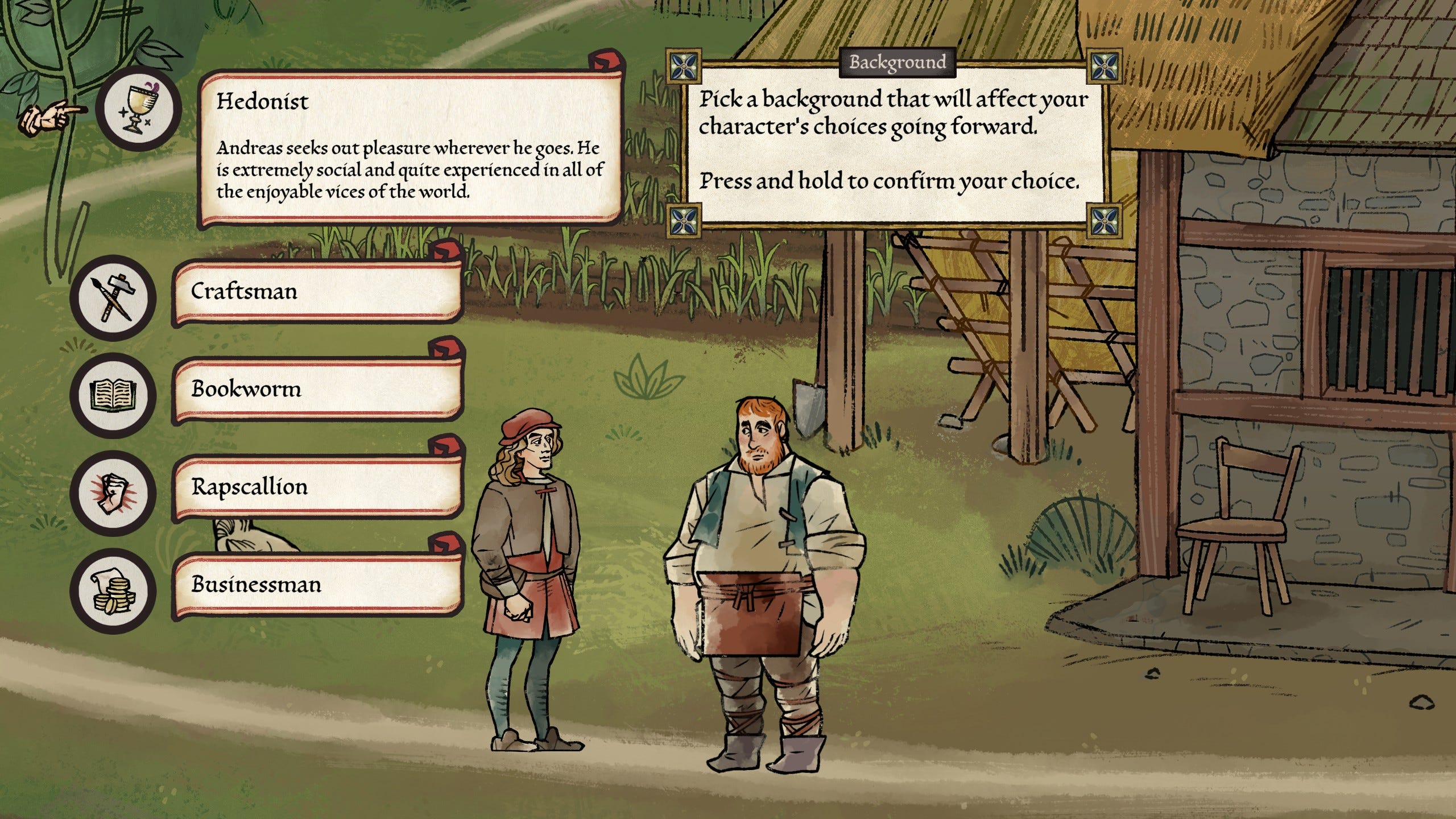
When I select the dialogue option assenting to ask for an advance, Pentiment notifies me that, “This will be remembered.” It's the first time I've received this message. I've made many dialogue choices, but apparently few of consequence. The next choice of consequence involves Andreas' background. When characters question Andreas' past, the player's answers determine his background. As I exit the house Big Jorg asks, “Where was it you spent your Wanderjahre before you came to Tassing?”
Possible answers include Basel, Flanders, or Italy. Pentiment explains the benefits of each choice. In this example, the choice alters Andreas' skill at languages, along with his knowledge of geography. Choosing Italy grants Andreas knowledge of Italian and a little Greek. He also knows relevant details about the Italian merchant cities of Florence, Venice, and Milan. Later choices let the player craft Andreas' character, his college education, and his interests.
Each time a dialogue choice would use this knowledge, it is preceded by an appropriate symbol. For example, any dialogue option that uses Andreas' Bookworm background features a book icon. His Theology education displays a decorated cross. While I preferred background based conversations, occasionally I chose the generic option to avoid offending my interlocutor.